Airline technology, explained from the ground up.
New to the industry? Understand how a flight moves from schedule to seat availability, shopping, pricing, reservation, payment and airport departure. No prior airline background. No vendor sales pitch. Just a rigorous, visual foundation.
See the whole system before learning the parts
This eight-stage map connects the commercial and operational systems that a new developer, analyst or product manager will encounter. It is a teaching model, not a prescribed IT architecture.
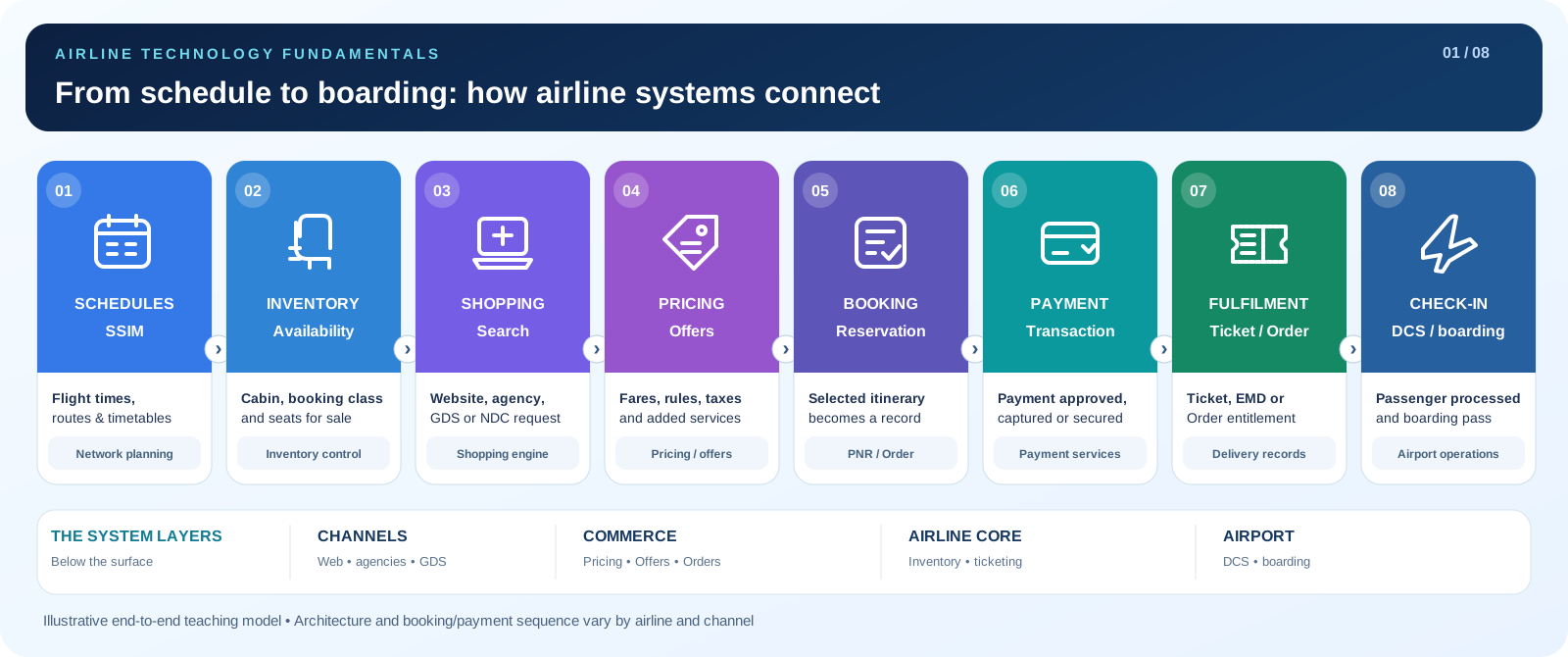
A clear route from newcomer to practitioner
Each chapter defines the terms, explains why they exist, walks through a vendor-neutral scenario and links to the original standard or source.
Start here: the full journey
Follow a passenger from schedule publication through check-in; see which systems touch each decision.
Read the journey →What the systems actually do
Understand PSS, CRS, GDS, OMS, DCS and their boundaries without mixing up functions and vendors.
Understand the systems →Availability, fares & prices
Why an available seat is not a fare, why RBD matters and why shopping is not the same as pricing.
Understand availability →PNR, ticket, EMD & Order
What the customer holds, what the airline records and why these identifiers are not interchangeable.
Learn the records →Distribution and NDC
How direct channels, agents, GDSs and airline APIs connect, and where modern Offers and Orders fit.
Map distribution →Airline technology glossary
Search plain-English explanations of the words and acronyms you hear in your first airline meeting.
Look up a term →For your first 30 days
Week 1: understand the end-to-end journey. Week 2: learn PSS, GDS, pricing and booking records. Week 3: compare legacy distribution with NDC and Orders. Week 4: use a simple failure scenario to trace which system owns the next action.
For deeper study, continue into the existing MAR learning paths and MART technical tools.
How this reference is written
Published IATA and ATPCO material grounds standards and terminology. MAR supplies the independent explanations, simplified system diagrams and learning exercises. Where workflows vary, we say so.
We do not claim every airline, GDS or PSS uses the same architecture.
Original industry sources
These are original publisher references, not substitutes for licensed standards manuals. Explanations, diagrams and learning examples on this site are independent educational interpretations.
- IATA Standard Schedules Information Manual (SSIM) — Schedule-data exchange and timetable definitions.
- IATA NDC — Offer and Order distribution messages.
- IATA ONE Order — Order-based fulfilment direction.
- IATA Airline Industry Data Model — Industry-agreed vocabulary and model concepts.
- IATA Passenger Services Conference Resolution Manual — Reservations, check-in and ticket issuance.
- ATPCO: how airline offers reach flight shoppers — Fares, rules, availability and offer distribution.
- IATA Common Use Standards — DCS-related airport devices and common use.
- IATA Billing & Settlement Plan — Agency sales reporting and settlement.
Start with one passenger, one journey.
Then use the glossary whenever an unfamiliar term appears.