From schedule to boarding: the airline technology journey.
A passenger sees a simple journey: find a flight, pay and travel. Airline systems coordinate many distinct records and decisions behind it. This guide starts with the big picture and names the system responsible at every stage.
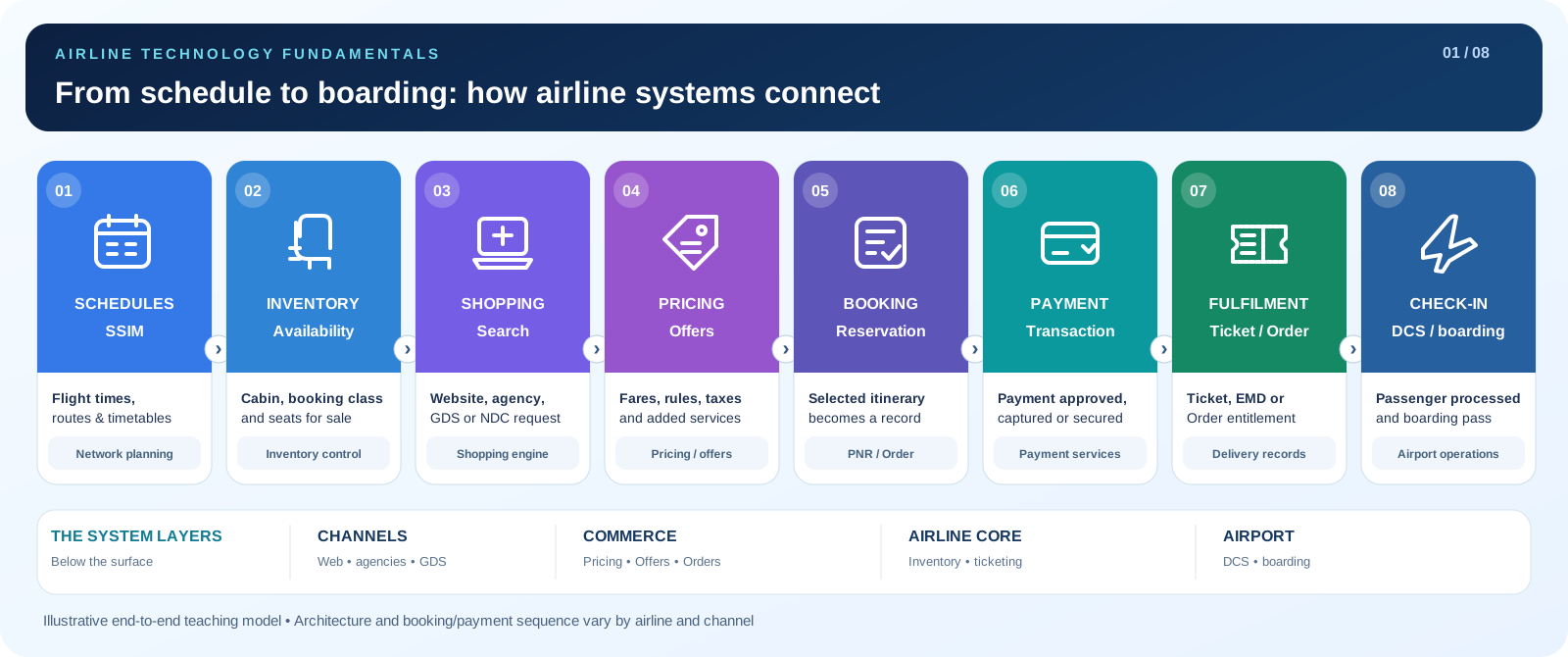
Eight connected steps, in plain English
Imagine a traveller booking a return flight on a fictional airline. Follow the same trip from the schedule record to boarding.
Schedule data and SSIM
A flight begins with a published operating plan: carrier, flight number, dates, route, timings and aircraft-related details. Schedule exchange helps other systems learn which services exist. SSIM addresses how schedule and related data are exchanged; it is not itself a seat-availability engine.
Network planning → schedule publicationInventory and availability
The schedule creates the service, but revenue management and inventory control help decide which booking classes can be sold. RBD is a booking-class designator, not a seat number. Availability can also depend on origin-destination context and controls rather than a simple count of empty seats.
Inventory host / revenue managementShopping request
A passenger searches a route and travel date. A direct website, agent, OTA, GDS or NDC-enabled seller requests options. A shopping response is a set of possible choices, not necessarily a confirmed booking.
Website / seller / shopping APIPricing and offer creation
Pricing combines eligible fares, fare conditions, taxes, optional services and the relevant commercial context. Filed fare and rule data commonly participate in traditional pricing. An Offer expresses what can be purchased under specified conditions and for a limited period in some flows.
Pricing / Offer management / ATPCO dataReservation or Order creation
Once the traveller chooses, the system creates or confirms a commercial record. In conventional flows that may be a Passenger Name Record (PNR); in Order-based flows an Order is central. Do not assume a created PNR also means payment is complete or a ticket has been issued.
Reservations / Order managementPayment
The seller or airline obtains payment approval and captures or otherwise secures the amount under the chosen workflow. An authorization is not necessarily the same as final capture. Some channels create or hold records before payment, while others require payment to commit.
Payment orchestration / providerTicketing and fulfilment
Traditional ticketed airline journeys use an electronic ticket for flight coupons and may use EMDs for ancillary services. Modern Order-based fulfilment seeks a different integrated record model. Delivery evidence, entitlement and accounting need to remain consistent.
Ticketing host / fulfilment / accountingCheck-in and DCS
Near departure, airport and self-service channels support identification, check-in, boarding-pass creation, bags and boarding. DCS interacts with operational and commercial data; it does not price or shop the itinerary again in the normal flow.
DCS / airport equipment / boardingFollow one passenger
Our imaginary traveller wants to fly on a Friday. The airline publishes a timetable for the route. That lets customers discover the flight, but it does not automatically mean every fare is still open for sale. Inventory controls decide which booking classes are available for a requested itinerary.
The traveller searches through a website. The shopping engine checks suitable flights and returns options. A pricing component then establishes which fare rules and taxes apply, and what extra services can be offered. The traveller selects one of those offers. Depending on the selling architecture, a reservation or Order is recorded, payment is obtained and the necessary flight and ancillary entitlements are issued or confirmed.
On travel day, the passenger checks in online or at the airport. The departure control system supports passenger processing and boarding. Meanwhile, financial reporting and settlement continue; those processes do not necessarily finish when the passenger boards.
Three distinctions you should learn immediately
Availability is not price. A booking class may be open but the final amount still depends on fares, taxes, rules, passenger context and products included.
A reservation is not a ticket. In traditional environments the PNR and e-ticket are different records. A confirmed itinerary is not proof that all documents or services have been fulfilled.
NDC is not a replacement for the whole PSS. NDC standardises distribution interactions around Offers and Orders. Airlines may continue to depend on traditional systems underneath the API.
What happens off the main line?
Revenue and inventory controls
Revenue management changes booking-class availability over time based on commercial objectives, demand and itinerary context. This affects what can be sold, not the existence of a scheduled flight.
Accounting and settlement
Payments, agency remittance, refund processing, service delivery and accounting have their own lifecycles. IATA BSP concerns airline and accredited-agency settlement, not every individual customer-card payment.
Knowledge check: can you explain a PNR without calling it a ticket?
A PNR holds booking information. An e-ticket is a distinct electronic entitlement and coupon record in traditional ticketed workflows. A customer can have a PNR before the ticket is issued.
Knowledge check: is SSIM itself an availability service?
No. SSIM standardises schedule information exchange. Inventory and availability are separate commercial functions that consume schedule context.
Original industry sources
These are original publisher references, not substitutes for licensed standards manuals. Explanations, diagrams and learning examples on this site are independent educational interpretations.
- IATA Standard Schedules Information Manual (SSIM) — Schedule-data exchange and timetable definitions.
- IATA NDC — Offer and Order distribution messages.
- IATA ONE Order — Order-based fulfilment direction.
- IATA Passenger Services Conference Resolution Manual — Reservations, check-in and ticket issuance.
- ATPCO: how airline offers reach flight shoppers — Fares, rules, availability and offer distribution.
- IATA Common Use Standards — DCS-related airport devices and common use.
- IATA Billing & Settlement Plan — Agency sales reporting and settlement.